

Avalanche Transceivers and Pacemakers: Keep Your Distance
- Mountain Rescue Technology
- Apr 10
- 2 min read
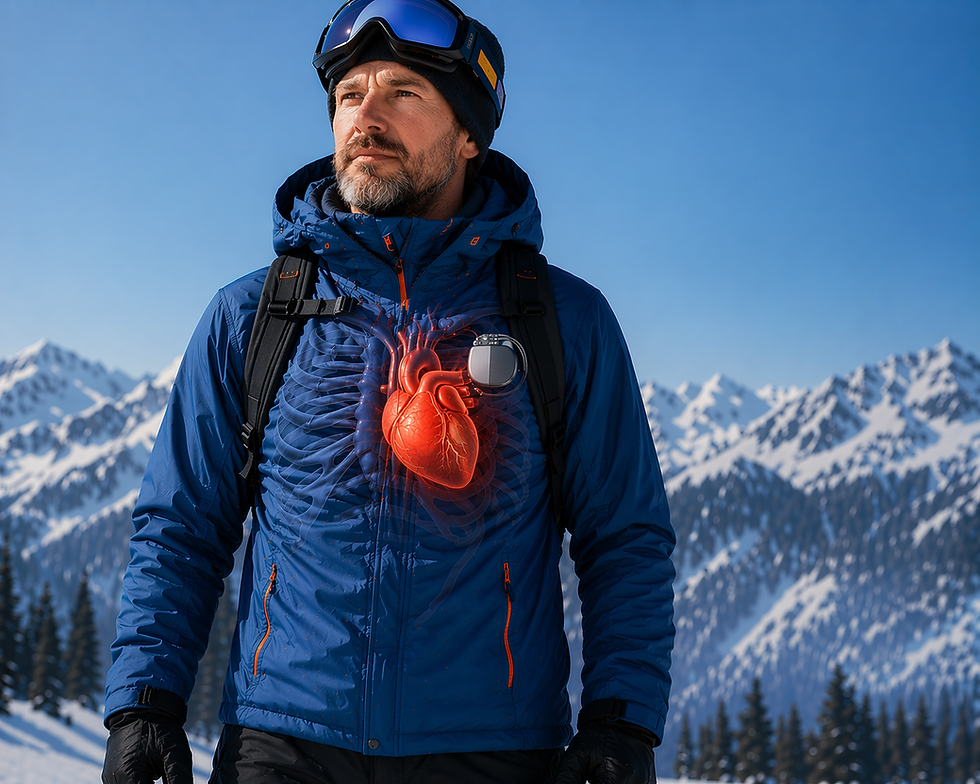
Pacemakers as a Potential Source of Interference
Avalanche transceivers operate using a weak electromagnetic signal at 457 kHz.This signal can be influenced by metallic or electronic objects in close proximity. These include pacemakers and implantable cardioverter-defibrillators (ICDs).
If such devices are positioned too close to the transceiver, the signal may be attenuated or distorted, potentially affecting search performance.
Manufacturer Guidelines: Be Careful with Carry Position
All avalanche transceiver manufacturers explicitly state in their user manuals that electronic and medical devices – particularly pacemakers – may interfere with the transceiver signal.
For this reason, they recommend maintaining a minimum safety distance between the transceiver and the implant:
Mammut (Barryvox S2, 2024):
“The signal of an avalanche transceiver can be affected by metallic or electronic objects, including pacemakers.
Minimum distance: 20 cm in transmit mode, 50 cm in search mode.”
Ortovox (Diract Voice, 2024):
“Electronic devices and pacemakers can influence the avalanche transceiver signal. Keep your distance!”
Pieps (PRO IPS, 2023):
“For pacemakers from Medtronic and Boston Scientific, a minimum distance of 20 cm is recommended; for other manufacturers, 50 cm.”
Practical Recommendation
For individuals with pacemakers or ICDs, the use of an avalanche transceiver is generally safe and unrestricted.
However, the device should not be worn directly over the implant.
Recommended carrying position:
In a trouser pocket or attached to a belt
Maintain at least 20 cm distance from the chest
Scientific Background
A clinical study conducted by the Medical University of Innsbruck (Nägele et al., 2013, Pacing and Clinical Electrophysiology) specifically investigated the interaction between avalanche transceivers and pacemakers or ICDs.
Key finding:
Avalanche transceivers do not interfere with the function of pacemakers or ICDs.
All implants functioned correctly during testing, and no malfunctions were observed.
Conclusion
While a pacemaker may influence the signal of an avalanche transceiver,the reverse is not the case:
👉 An avalanche transceiver does not impair the function of a pacemaker or ICD.


Comments